


Summary
The US and Iran have agreed a deal to end the war, which mediator Pakistan says will be signed on Friday in Switzerland
Donald Trump says the Strait of Hormuz will be reopened and the US naval blockade of Iran will end
Oil prices have fallen since the announcement – and there is “now every chance of avoiding a prolonged energy shock”, writes the BBC’s Faisal Islam
The deal includes an end to “military operations” in Lebanon, which has welcomed it. However, Israel says its forces will remain in the country indefinitely
In Iran, the agreement is being framed as a victory for Tehran and a defeat for the US and Israel
The full text is yet to be published and questions remain over crucial issues, including on what happens to nuclear material in Iran, writes the BBC’s Anthony Zurcher
An agreement in the nick of time for oil market
 Dharshini David
Deputy economics editor
A sigh of relief for markets.
The price of oil, however, remains higher than before the conflict, it will take months for output in the Middle East to get back to normal.
Oil production there has halved. And the higher prices of the last few months will take a while to filter through supply chains – meaning inflation will remain elevated for some months, though by less than once feared.
But this agreement has come in the nick of time. There had been fearful mutterings of a tipping point in the oil market lately, a looming supply crunch.
The drop in Middle East production had been partially compensated by America ramping up production – and China in particular drawing down reserves.
Yet the fear was reserves globally could reach perilously low levels as soon as July – risking pushing up prices and difficult choices for government, households and companies.
That, as long as the peace holds and the shipments resume flowing, has been averted. All eyes on the strait.
Two more vessels appear to be exiting the strait
By Shruti Menon
Ship-tracking data from MarineTraffic shows two more vessels – both cargo ships – are heading out of the Strait of Hormuz and into the Gulf of Oman.
Comoros-flagged cargo ship Blue Ocean 1 is partially laden and had its location transmitter off during the transit. It has switched it back on as it comes close to the exit.
The vessel called at Iranian anchorages in May according to port call logs from MarineTraffic.
A second cargo vessel called Kaiser attempted to pass through the strait on 12 June but turned back. We don’t know why, but it appears to be crossing again laden with cargo.
Both vessels are broadcasting Sohar port in Oman as their destination.
Traffic through the strait has remained low with only two to five vessel crossings a day in the past week according to maritime intelligence company Windward, compared with more than 100 ships transiting every day before the conflict started on 28 February.
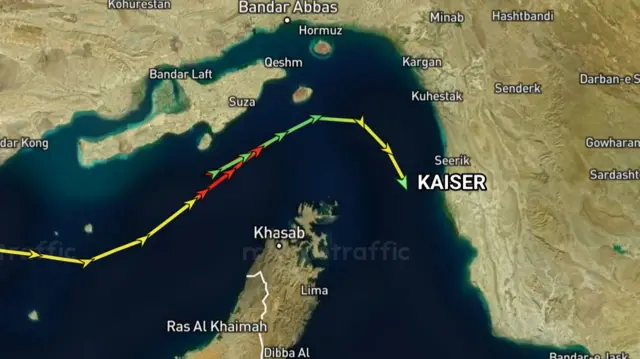 Kaiser appears to be crossing the strait again laden with cargo
Trump says ships are ‘starting to move’ through Strait of Hormuz
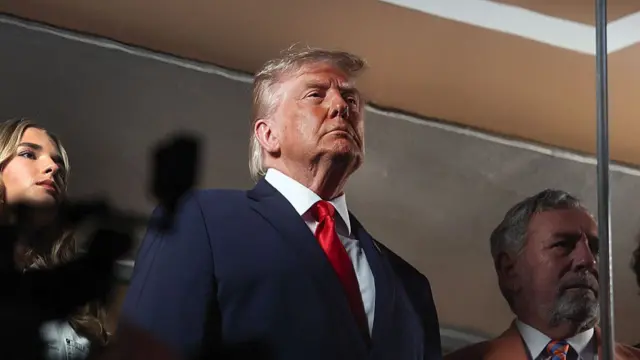
US President Donald Trump says ships “are starting to move, many loaded up with Oil, out of the Strait of Hormuz” after the US and Iran reached a framework deal.
Writing on Truth Social, he says: “They are going along the Southern “Highway,” which is totally safe, secure, and pristine. There are other areas of travel, also!!! President DJT”.
Our colleagues at BBC Verify have been looking at ship-tracking data and reported earlier a tanker was seen crossing the strait hours after the deal was announced. We’ll have more from them very soon.


