


Summary
Iran’s Islamic Revolutionary Guard Corps (IRGC) says it has hit two UAE tankers in the Strait of Hormuz, as the US carried out a third night of strikes in a row on Iran
The UAE called the attack “brazen”, adding that an Indian crew member was killed and eight others were injured
The IRGC also confirmed it had targeted US facilities in Jordan and Bahrain overnight
Meanwhile the US military says it has completed strikes on targets aimed at degrading “Iran’s ability to attack commercial shipping”. Iranian state media reports three people have been killed in the strikes
Oil prices have continued to rise, with benchmark Brent crude up more than 3% at $86.07 a barrel
It comes after President Donald Trump said the US was reinstating a naval blockade of Iranian ports and would impose a 20% charge on all cargo shipped through the Strait of Hormuz – what we know so far
Where does the ceasefire stand now? Neither side has said the memorandum of understanding is completely dead, but more and more, they are behaving as if it is, writes our correspondent in Jerusalem
Explosions heard in multiple locations – Iranian state media
Several explosions have been heard near the port city of Bandar Abbas, according to Iranian state media.
The state-run IRNA has said four locations were hit by projectiles in the city of Bushehr, with the Fars news agency saying residents have reported hearing multiple explosions.
We’ve contacted the US Central Command for comment on this.
India summons Iranian ambassador over attacks that killed Indian crew member
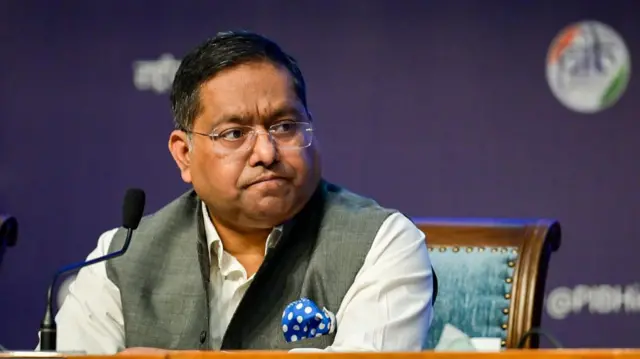 India’s Ministry of External Affairs spokesperson Randhir Jaiswal
India’s Ministry of External Affairs says one Indian crew member was killed and 10 others were injured in Iranian attacks on two vessels in the Strait of Hormuz.
Two tankers – named in the statement as the “Al Bahiyah and Mombasa” – carrying a combined 46 crew members, were struck by Iranian cruise missiles off the coast of Oman overnight.
One of 12 Indian nationals onboard the Al Bahiyah was killed in the attack, while another was injured, according to a statement issued on X by ministry spokesperson Randhir Jaiswal.
There were 18 Indian nationals onboard the Mombasa, of which nine sustained injuries, including two who are reported to be seriously injured, it adds.
India’s Ministry of External Affairs says it has summoned the deputy ambassador of Iran to lodge “a strong protest against these attacks”.
“We strongly condemn these attacks and acts of violence targeting seafarers and disrupting free and safe navigation through international waterways like the Strait of Hormuz,” the statement adds.
Trump’s 20% tolls are another curve ball in negotiations over Strait of Hormuz
 Lyse Doucet
Chief international correspondent
President Trump has thrown another curve ball in saying the US will now start charging tolls of 20% in the Strait of Hormuz.
Shipping experts say that could double costs through an already all too costly maritime corridor. It also contradicts what the Secretary of State Marco Rubio has repeatedly said is US policy – that no one should charge tolls in what they regard as international waters.
It’s not clear this is legally, politically, or logistically possible. Iran has swiftly exploited the president’s remark to underline what they see as their right to impose some form of fees.
The foreign minister Abbas Aragchi posted on social media that “20% is of course too much. We will be fair.” For Tehran, its presence in this strategic strait is non-negotiable.
Yesterday Iran’s parliament introduced a “Strategic Action” plan to manage the waterway. The hard-line head of the national security committee, Ebrahim Azizi, wrote “we remain steadfast in defending our red lines.”


