


Israel says it has targeted a “major” missile and sea mining production facility in central Iran – read analysis on the role of sea mines in the war
Brent crude rises above $110 a barrel again, a day after Donald Trump said he would postpone plans to start destroying Iranian energy plants by another 10 days
Iran hasn’t publicly reacted to Trump’s decision, but Tehran earlier said it was waiting for Washington to respond to its conditions for a ceasefire – what are they?
At a cabinet meeting, special envoy Steve Witkoff confirmed the US had sent Iran a 15-point peace plan – how realistic is a deal? Read international editor Jeremy Bowen’s analysis
The UN’s human rights chief says a deadly strike on an Iranian school on the first day of the war sparked “visceral horror” – a mother whose two children were killed says the “truth must be brought to light”
Israel and Iran have continued to exchange strikes – one Iranian tells BBC Persian “the sound of missiles was mixed with the thunderstorm” overnight
Iran’s survival rests not with any individual, but with the institution
 Jeremy Bowen
International Editor
Despite the US and Israel killing Iran’s supreme leader and other top officials, Iran’s regime is surviving in this war.
The important thing to know about the structure of the Iranian regime is it’s not really about names, it’s about an institution.
The reason the regime has proved to be so resilient is, unlike Libya under Gaddafi, it has these institutions. It’s not based on individuals.
If a system is institutionally based, it means if individuals go the institution ploughs on.
After the Libyan leader Gaddafi was killed in 2011, the institution had been totally hollowed out by the regime and the whole thing collapsed. Iran is a very different proposition.
As well as those institutions, an iron-clad religious ideology exists, in combination with nationalism and an ethos of martyrdom, resistance and survival.
Rubio’s task at G7 talks is to sell the US strategy of war
 Nomia Iqbal
News correspondent, in Paris
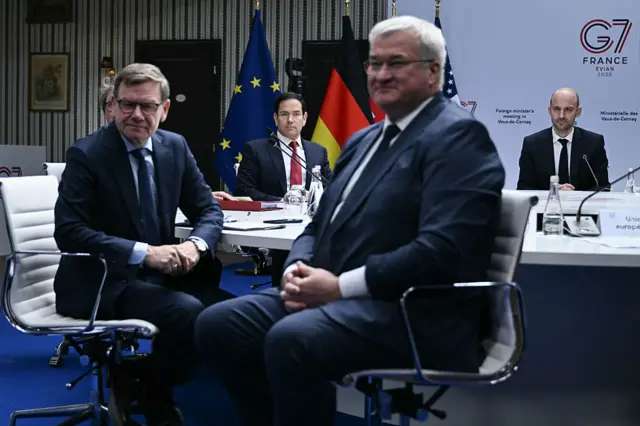 Image source,Getty Images Image caption, Marco Rubio (back), with his Ukrainian, German, French and British counterparts at a G7 Foreign Ministers’ meeting in France
US Secretary of State Marco Rubio is currently meeting with his counterparts at crucial G7 talks in France.
This is Marco Rubio’s first foreign trip abroad since the war started. He has the inevitable task of essentially selling the US strategy of the war to other G7 members.
France, Italy, Germany, Japan, Canada and the UK released a statement several days after the war began condemning Iran’s retaliatory strikes but notably didn’t comment on US and Israel who started the war.
Broadly speaking, the other G7 members don’t want to be sucked into this war but economic pressure may force them to take some sort of position that draws them closer. Re-opening the Strait of Hormuz is one of the key issues they’ll be discussing.
As far as Rubio is concerned, Europe owes the US.
He said before boarding the plane, Ukraine wasn’t America’s war yet they’re helping as a way of justifying why Europe should help the US.
It’s not really a clear equivalence, but it’s effective political rhetoric which puts European leaders into a further bind.


