


Summary
Keir Starmer announces an additional £15bn in funding for defence ahead of a long-awaited spending plan being published today
UK defence spending will be £80bn a year by 2029, he says, adding that some road and energy projects will be scrapped to fund it
“When the world is arming and aggression is rising, the best way to avoid war is to prepare for it,” he says in a speech – read a recap here
The defence investment plan (DIP) will include £5bn to increase the armed forces’ use of drones and autonomous weapons – three key tests for the plan
It also includes plans for the Royal Navy to become a “hybrid navy”, using self-controlled vessels and AI alongside warships and aircraft and funding for six new warships
Tory leader Kemi Badenoch calls the plan insufficient and “barely half what the armed forces say is needed”, while Liberal Democrat leader Ed Davey says it’s “late and underfunded”
How does UK defence spending compare with other Nato members?
By Tom Edgington
Speaking about the government’s Defence Investment Plan (DIP) earlier, Prime Minister Keir Starmer said an extra £15bn would be spent on the UK military, which he described as a “massive step forwards”.
But how does UK defence currently compare with its Western allies?
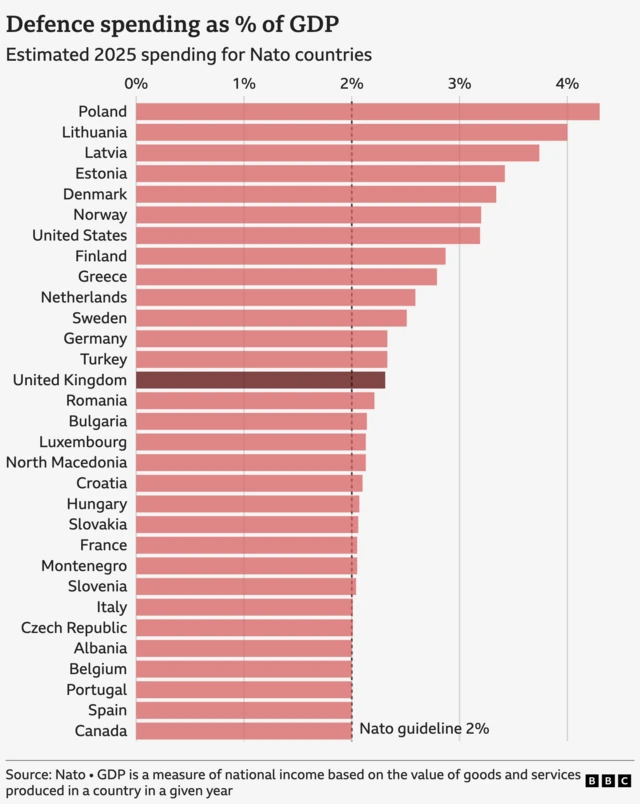
According to Nato estimates for 2025, every country in the alliance achieved the previous 2024 target of spending at least 2% of the size of their economy (measured by GDP) on defence.
Last year the UK spent 2.3% – putting it 14th among the 32-member alliance.
In cash terms, the US is still by far the single biggest spender on defence, spending about $980bn (£720bn) last year – 60% of the Nato total.
Nato members are now committed to spend 3.5% of GDP on core defence by 2035.
Speaking this morning, Starmer said defence spending would rise to 2.7% “putting us on a trajectory to reach 3% in the next parliament“.
However, he did not specify in which year defence spending is expected to reach 2.7% of GDP.
We’ll be able to go into more details about the proposed extra spending when the DIP is published in full – that’s expected to be this afternoon.
UK defence needs ‘best possible chance’ in changing environment, says degree apprentice
 Yasmin Malik
BBC Newsbeat

Today’s investment plan will affect Oliver Tatlow’s job.
Tatlow, 22, is a systems engineer degree apprentice at Leonardo – a supplier of defence and security equipment to the Ministry of Defence (MoD).
He says the threats facing the UK are “changing all the time”, but that those working in the UK’s defence need to be given “the best possible chance in that environment”.
“What we do protects our people, who can then protect us,” he says.
Tatlow has worked on the RAF’s Typhoon combat aircraft and is also studying a degree in electronic engineering.
He feels that people and recruitment are crucial to keeping the country safe, and that the UK needs “more apprentices and graduates coming into defence”.
“We can prepare, we can react, but through all of that we need people.”
Nato chief says defence investment plan is ‘good step’ towards 3.5% GDP target
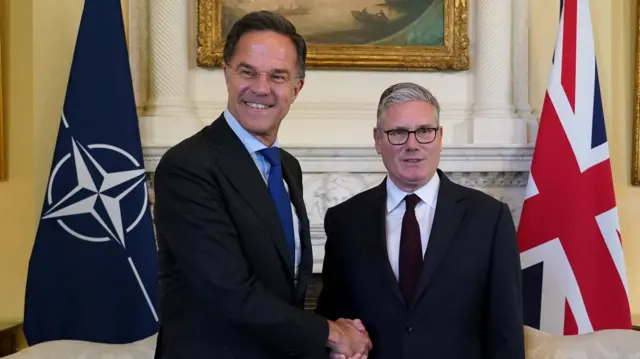 Prime Minister Keir Starmer met Mark Rutte, Nato secretary-general, at No 10 yesterday
Nato secretary-general Mark Rutte says he welcomes the defence investment plan, arguing that “stronger UK defence makes us all safer”.
Speaking shortly after Keir Starmer’s speech, Rutte says the plan “is a good step towards reaching the 3.5% of GDP on defence agreed in The Hague last year”.
He says defence spending and production will be “an important focus” at the Nato summit in Turkey next week.
It follows a meeting between Starmer and Rutte at No 10 yesterday, after which the Nato chief thanked the prime minister for “everything” he had done during his premiership.


