

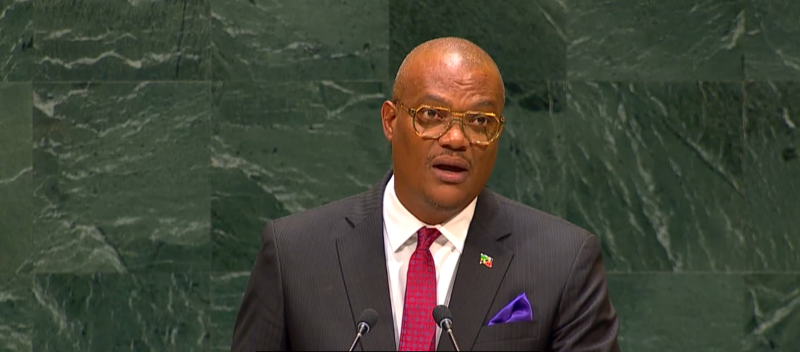
St. Kitts and Nevis (WINN)—As the United Nations General Assembly general debate continues, the Federation’s Deputy Prime Minister, Hon. Dr Geoffrey Hanley, is calling for action rather than more promises and commitments from the global community.
Dr Hanley says that at a time when the world is not short on promises, declarations or commitments, what is needed is proof that international institutions can respond to the realities people are facing.
|”For small island developing states like ours, the question is immediate. St. Kitts and Nevis therefore comes with a clear proposition. Trust will be restored not by what we promise, but by what we deliver. The time has come to move from promise to proof. I come not only to speak about what the world must do, but to account for what we are doing. Mr President, last year our Prime Minister, Hon. Dr Terence Drew, spoke of our sustainable island state agenda, CISA, our national blueprint for transforming St. Kitts and Nevis into a more resilient, sustainable, inclusive and prosperous society by 2040. Today, we return to demonstrate that it is becoming a record of delivery.”
Deputy Prime Minister also highlighted the progress made by the Federation in improving water services.
“Earlier this year, our second voluntary national review in the United Nations High-Level Political Forum showed stronger government coordination, close alignment with sustainable development goals and tangible progress for our people. Water provides one of the clearest measures of that progress. One year ago, our 2 million gallons per day solar power desalination plant was nearing completion. In February, we commissioned it. Through semi-airborne drone surveys, we also identified 17 new potential groundwater sources and, in August, completed drilling at the first rural site. Together with distribution upgrades, these investments are strengthening water security. In 2022, only 25% of our households had 24/7 water. Today, approximately 75% do. This is transformational.”
He also pointed to the progress being made in renewable energy on Nevis.
“On the island of Nevis, we are advancing a 30-megawatt geothermal power development, with drilling expected by early 2027, and Icelandic drillers contracted to begin the process. In St. Kitts, plans for a 50-megawatt solar PV and battery storage project are well advanced. These investments will reduce dependence on imported fossil fuels and strengthen economic resilience. We are also strengthening food security through climate-smart support for farmers and healthcare through our locally developed National Digital Health Information System at the Joseph and Franz General Hospital. Sustainability must be practical, people-centred, and built to last. Mr President, there is more to do, but our experience proves that small states are not powerless. With investment, partnership, and political will, small nations can deliver big solutions. St. Kitts and Nevis is not seeking pity. We are advancing partnership. A sustainable island state is not a distant ambition. We are building it today.”
During his speech on Friday, Dr Hanley emphasised the Federation’s strong position on climate change, while pointing to the challenges that include changing rainfall patterns.
“Yet, even as we advance, the climate crisis is moving the goalpost. This year, our Federation and the wider Caribbean faced severe drought. By the end of May, rainfall was 44% below the long-term average. We are investing in resilient infrastructure, but no small island developing state can adapt indefinitely to a crisis the world continues to intensify. Adaptation cannot excuse inaction elsewhere.”
The Deputy Prime Minister also drew attention to the changing heat environment and its impact on countries like St. Kitts and Nevis.
“Distinguished colleagues, the science is unequivocal. The years 2015 to 2025 were the warmest on record, and in 2025, global average temperature remained about 1.43 degrees Celsius above the pre-industrial baseline, while global mean sea level stood approximately 11 centimetres higher than in 1993. For island nations, this is a question of sovereignty and statehood. If our coastlines retreat, our sovereignty must not. Mr President, climate-induced sea level rise must never erase a state’s international legal personality, extinguish its UN membership, deprive its people of nationality, or diminish lawfully established maritime zones of sovereign rights. The International Law Commission has laid foundations for continuity of statehood, sovereignty, and maritime entitlements. This assembly must turn them into firm guarantees.”
The federal regime supports decisions made by the International Court when it comes to climate change.
“International law has spoken with increasing clarity. St. Kitts and Nevis welcomes the International Court of Justice advisory opinion on states’ climate obligations. Clarification must now become compliance. Commitments must become conduct, and promises must become performance. States must reduce emissions, strengthen adaptation, honour climate finance responsibilities, and cooperate with countries bearing consequences vastly disproportionate to their contribution to this crisis. Mr President, those who contributed least must not pay the greatest price.”
Federation Deputy Prime Minister Hon. Dr Geoffrey Hanley speaking at the United Nations 81st General Assembly.


