

Summary
SpaceX is set to send its Starship spacecraft into orbit around the Earth for the first time – watch the launch live above
The rocket will make approximately six orbits of the Earth during a 10-hour flight, deploying satellites, before splashing down in the Pacific Ocean to the west of Chile
While the rocket enters orbit, the booster is set to splash down in the Gulf of Mexico minutes after being launched from Texas – a breakdown of how the mission will unfold
Starship is the largest and most powerful spacecraft ever built, and SpaceX says it will eventually carry crew and cargo “to Earth orbit, the Moon, Mars and beyond”
The aim of the spacecraft – which will undergo its 14th test flight today – is to be able to carry up to 100 people on “long-duration, inter-planetary flights”
Teams begin loading propellant
SpaceX says its teams have begun loading Starship with propellant – as mentioned before they say that’s about 12 million lbs (5.4 million kg) of liquid oxygen and liquid methane.
The rocket is being loaded at the Starbase facility in Texas.
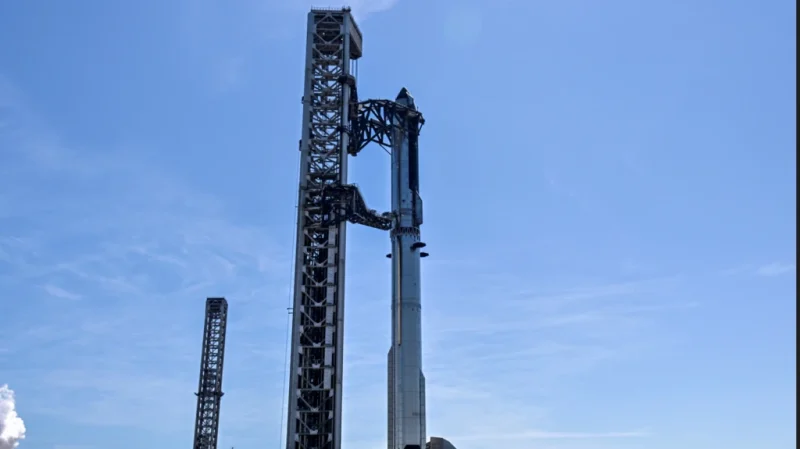
Putting the ‘Ship’ in Starship
So, what components make up the Starship rocket?
The Ship is the uppermost part of the rocket. It sits atop a booster called Super Heavy.
SpaceX aims to make it completely reusable. SpaceX has previously successfully manoeuvred the Super Heavy booster back to the launch pad. It is yet to catch the Ship in the same way.
Today, the Super Heavy won’t be caught though, it will instead land in the sea.
The rocket consists of thirty three engines which produce around 74 meganewtons of thrust – almost 700 times as powerful as the thrust generated by the common passenger plane, the Airbus A320neo.
If you’ve flown with Aer Lingus, British Airways or Lufthansa, imagine the kick of taking off in one of those planes. Then multiply that by 700.
It’s also about twice as powerful as the Saturn V rocket which first took humanity to the Moon’s surface.
SpaceX says that power should be able to move a payload weighing at least 150 tonnes from the launchpad to low-Earth orbit.

Fireballs and space station drop offs: The rockets that have led up to this point
SpaceX was founded in 2002 and has developed several vehicles since then, including the Dragon capsule and Falcon 9 rocket, which have taken astronauts to the International Space Station.
SpaceX engineering executive Bill Riley describes these and other models as the “building blocks along the way” towards Starship.
It is Starship that SpaceX hopes will ultimately travel to the moon.
But this could take time. In 2016, Musk said he was planning to send his Dragon spacecraft to Mars as early as 2018. Eight years have passed since that target.
And recent suborbital missions haven’t all been smooth sailing.
There were several Starship incidents in 2025, including an explosion shortly after launch in March which grounded flights and caused debris to rain down over the Bahamas.
In June, the rocket exploded into a gigantic fireball on its test stand.
This was followed by a third failed mission in May, when Starship began spinning out of control minutes after separating from its booster.
Missions since have been more successful, although not without blips entirely.
A flight in May this year saw both stages of the rocket suffering engine failures, despite otherwise achieving most major mission objectives.


