

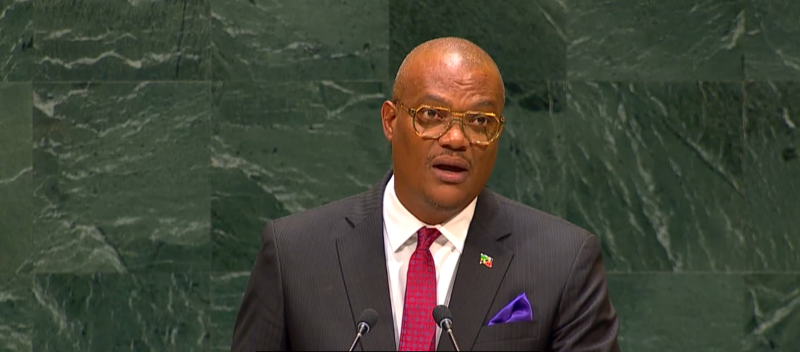
St. Kitts and Nevis (WINN)—Deputy Prime Minister Hon. Dr Geoffrey Hanley is calling on the international community to move from agreements to action in addressing critical issues affecting small island developing states, including St. Kitts and Nevis.
Hanley, who delivered the Federation’s statement during the ongoing United Nations General Assembly in New York, highlighted the growing challenges posed by climate change to small island states.
He pointed specifically to the marine biological diversity of Areas Beyond National Jurisdiction (BBNJ), commonly known as the High Seas Treaty.
“Our oceans must also move from promises to protection. St. Kitts and Nevis ratified a BBNJ agreement in 2025. Implementation now matters. Large ocean states need access to capacity building, marine technology, scientific knowledge, and financing, while benefits from marine genetic resources must be shared fairly. For island nations, the ocean is not the space between us and the world; it is our highway, heritage, livelihood, and lifeline.”
As countries across the region continue to grapple with the effects of climate change and the need for greater access to financing, Hanley said the time has come for multilateral agencies and donors to consider the Multidimensional Vulnerability Index, or MVI, when assessing developing countries.
“Across climate action, sea level rise and ocean governance, one reality remains: resilience has a cost. For decades, small island developing states have argued that income is not the same as resilience. Mr President, per capita income cannot show exposure to hurricanes, droughts, pandemic shipping disruptions, energy shocks, conflict, or tourist collapse, nor how quickly one shock can erase years of investment. This year, St. Kitts and Nevis stood before the United Nations and completed the Pilot Vulnerability and Resilience Country profile under the Multidimensional Vulnerability Index framework. And what did we learn? We learned what our grandparents always knew. A house can look strong from the road and still have rot in the rafters.”
He said the vulnerabilities faced by small island states are often not reflected in the traditional economic indicators, including the gross national income.
“Vulnerability is not a statistic. It is a roof that was destroyed in Hurricane Beryl. It is a school that became a shelter. It is a family rebuilding for the third time in a decade because storms have no patience for GNI per capita. Mr President, we are not asking that gross national income be discarded. We are asking that it stop being expected to tell a story it was never designed to tell. GNI can count our coconuts and our cool ships. It cannot count our courage, and it cannot count the price we pay to simply remain. It cannot capture the cost of rebuilding the same bridge, clinic or seawall again and again while nations twice our size and half of our vulnerability borrowed cheaper than we do.”
Against this backdrop, Hanley challenged major international institutions to rethink the way they assess and support developing countries.
“We therefore call on the World Bank, the IMF, Development Banks, Climate Funds and every partner here to incorporate MVI into the architecture of financing, not as charity, but as arithmetic and justice made real. If vulnerability can be measured, it must be considered.”
The question now is whether these institutions will heed the calls that small island developing states have been making for several years.


